5 challenges holding warehouse performance back
–and how to solve them
Click the links to browse the different sections
- Executive Summary: What’s Holding Performance Back?
- A Normal Tuesday in a Stretched Warehouse
- Challenge #1: Decisions Slow Down When the Flow Is Not Visible
- Challenge #2: The Warehouse Space Starts Limiting What You Can Sell
- Challenge #3: Peak Periods Take Away Your Recovery Time
- Challenge #4: The Stop May Be Short. The Recovery Is Not
- Challenge #5: Labor Dependency Keeps Your Operation Fragile
- Whats next: A Practical Way Forward
- Conclusion: Make the Warehouse Work as One System
What’s Holding Performance Back?
That is the question we want to answer in this white paper.
There are hundreds of things you can measure in a warehouse to judge its efficiency. But your customers only care about three things – whether the product is available, when the order arrives, and if it’s the right products that arrive.
They do not care about your slotting logic, your WMS, your labor plan, or the systems you use.
We work with warehouses of different sizes, across industries and markets. Some are taking their first steps in automation. Others are managing high volumes and more complex flows every day. Across all of them, the focus is the same. Keep performance high as volumes, expectations, and requirements change.
The day-to-day challenges may look different, but the drivers behind them are often the same. We see five challenges return again and again. Limited visibility, space constraints, peak volatility, unplanned stops, and dependency on labor. When one part of the operation falls behind, the resulting domino effect can be difficult to stop.
Running a warehouse in that reality is demanding. The result is a constant tension between what the business wants to promise and what the operation can reliably deliver.
This white paper takes a closer look at five challenges that affect modern warehouses, along with practical ways to solve them.
The aim is to help you see what is holding performance back, where to focus first, and what to look for in an automation partner.
I hope you enjoy the read.

How the challenges compound
A Normal Tuesday in a Stretched Warehouse
Inbound is running late, and Tom is already making his first trade-off of the day.
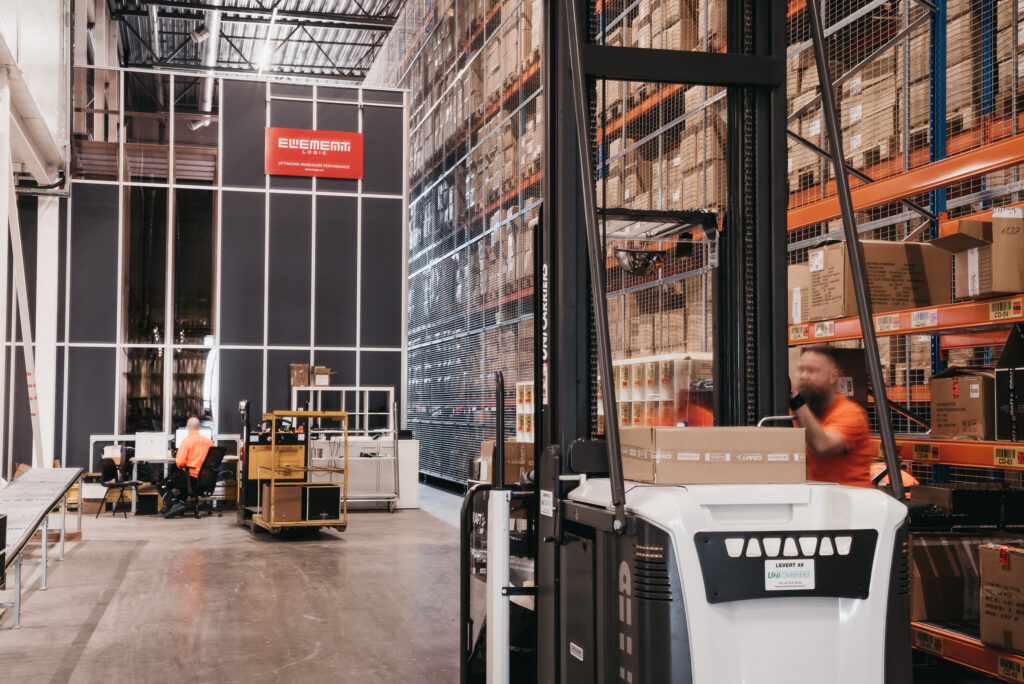
Tom is the warehouse manager. His team starts unloading, scanning, and staging the incoming goods, but putaway is slower than planned. Locations are tight, and the fastest-moving items are spread across too many places. He keeps products in staging for longer than he wants to.
By mid-morning, outbound starts pulling attention. Customer orders keep coming in, and the mix is different from yesterday’s plan. Some lines are waiting for stock that is still in staging. Other items are available, but pick-paths are longer because space pressure has pushed products into less practical locations.
The team can still pick, but it requires more steps and more coordination.

Tom needs to understand where the pressure is building. But the information sits in different systems and routines. One person checks the conveyor. Another checks the workstation. Someone else looks at stock in storage. The warehouse keeps moving, but finding answers takes time.
To protect shipments, Tom moves a few people from inbound to picking. Outbound improves for an hour. Inbound falls further behind. Pallets and totes remain in staging, taking up space that was already scarce. Putaway slows down even more.
Later that afternoon, a small technical issue appears. A workstation stops, a sensor misreads, or a conveyor segment needs attention. In a warehouse with more buffer, it would be an annoyance. Here, it becomes a bottleneck. Queues build up, and the team starts rerouting tasks manually. That means more handling and more room for error.
By the late shift, the warehouse is still shipping orders. It has managed through overtime, workarounds, and people solving problems as they happen. The cost is lower productivity, higher stress, and less reliable performance. The next day starts with less buffer and more backlog.
This is a fictional example, but the situation is familiar to many warehouse teams.
“The details may vary, but the same drivers often sit behind them. Limited visibility slows decisions. Space pressure increases travel and exceptions. Small technical issues disrupt the flow. Labor gaps force shortcuts when accuracy matters most,” Terje Skjølberg, Group Sales Director, explains.
In the next sections, we look at these five challenges and practical ways to solve them.
Helly Hansen automated its operations with Element Logic in 2022. Andrew Aldworth, Quality Compliance Manager, explains the impact:
“It took us from 1970 to 2030 overnight. It is one of the smartest investments we have ever made”
Andrew Aldworth, Quality Compliance Manager at Helly Hansen
🔍 How to Prevent the “Normal Tuesday” From Becoming Normal
The problem in Tom’s story is handovers. Goods, orders, and decisions move between zones, systems, and teams. Each handover adds waiting, manual checks, and small delays that stack up.
A warehouse is easier to run when one partner designs the flow end-to-end and takes responsibility for how the pieces work together. That is also how you avoid getting stuck. When the warehouse needs to expand or change, you want a setup that can evolve without a rebuild and without a blame game between suppliers.
Element Logic has worked with warehouse performance since 1985. We started by timing warehouse work with stopwatches and counting steps and have since evolved into a trusted solution partner for warehouses worldwide. We use that experience to design solutions that work in daily operations – and stay workable as requirements change.
You can only improve warehouse flow if you understand what happens on the floor.
Challenge #1
Decisions Slow Down When the Flow Is Not Visible
The Challenge
Modern warehouses generate information all day. Orders, stock, movements, people, and workflows all leave signals behind. The challenge is that these signals often sit in separate systems or separate routines. Each view may be useful on its own, but the warehouse still lacks one clear picture of how the full flow is performing. That makes it harder to see where pressure is building, what is causing delays, and which action will have the biggest effect.
Why it happens
Warehouse Systems Grow Separately
Most warehouses grow in layers. A process is added here, a system there, a new automation area somewhere else. Each part has a purpose, and each part may work well on its own. The difficulty comes when the warehouse needs to understand performance across all of them.
That shared view of how the warehouse performs becomes especially important when the operation is under pressure. A drop in output may be linked to stock placement, order mix, congestion, staffing, equipment status, or a change in priorities. If the information sits in different places, the team must piece together the answer before they can act.
That slows down daily decisions and makes improvement work harder. It also means opportunities are missed. Capacity may sit unused in one area while another area is overloaded. Recurring delays may look like isolated incidents. Small problems may continue because nobody sees their full effect on the flow.
The solution
Make Operational Data Easier to Act On
You need to create an operational layer that helps teams understand what is happening across zones, equipment and processes while the day is still running.
The operational layer should help the warehouse execute more efficiently. It should show where work is building up, where capacity is available, which priorities need attention, and where performance can improve. This gives supervisors a clearer base for decisions and reduces the need for manual follow-up between teams.
The Element Logic Software supports this by connecting warehouse systems, equipment, and operational data in one execution layer. It works alongside the systems already in place and helps teams coordinate priorities, monitor performance, and understand where flow can improve.
The result is that your teams spend less time gathering information and more time acting on it. Supervisors can see the effect of decisions across the full operation. Improvement efforts become easier because the warehouse team has a clearer view of what is happening, rather than relying solely on what each individual system reports.
A shared view also gives the warehouse a stronger foundation for future changes. When you understand how the operation behaves, you can add automation, adjust layouts, change processes, and expand capacity with more confidence.

We at Element Logic are working toward a more unified software experience for warehouse operations. The ambition is to help customers move from connected systems to more intelligent and autonomous flows
Stian Åsen, Product Manager at Element Logic
🔍 From Visibility to Dark Warehouses
“The long-term direction of warehouse automation points toward more connected and data-led operations. More decisions will be supported by live information. More tasks will be automated. More systems will need to work together. We call it a dark warehouse, where large parts of the operation run with very limited human intervention,” explains Stian Åsen, Product Manager at Element Logic.
Most warehouses will not move to that stage in one leap, and many may never need to become fully dark. The important question is whether your setup today makes tomorrow’s improvement easier or harder.
A warehouse that can control flow across systems is easier to adapt. New equipment can be added with less disruption. New processes can be added with more confidence. Performance improvements can be based on real operating data instead of assumptions.
“We at Element Logic are working toward a more unified software experience for warehouse operations. The ambition is to help customers move from connected systems to more intelligent and autonomous flows,” Åsen says.
Challenge #2
The Warehouse Space Starts Limiting What You Can Sell
The challenge
As assortments grow, the warehouse space can become the reason the business cannot expand product lines, hold enough stock, or serve customers as quickly as planned. More SKUs, smaller orders, and mixed demand profiles take up space and increase travel. The result is a warehouse that works harder for every order, while throughput slows and cost per line rises.
Why it happens
Space As the Growth Limit
SKU growth is rarely something a warehouse can plan for cleanly. New product lines get added, slow movers stay in stock because customers still need them, and seasonal items take space before demand arrives. At the same time, fast movers still need to stay in easy-to-reach locations. All of this competes for the same floor space, alongside returns, replenishment, and order preparation.
As space runs short, products get pushed into less practical locations, which makes pick paths longer and replenishment harder to plan. Operators end up spending more time walking, searching, waiting, or handling stock.
At that point, space pressure can even affect the commercial side of the business, because the warehouse layout starts shaping what the company can realistically offer customers.

The solution
Maximize Your Space Beyond the Floor
The first step is to look beyond the floor space. Square meters tell you how much space you have, but not how well it is being used. A warehouse that also accounts for how much of the building’s volume is used, how fast each product moves, how often it needs to be accessed can see which items deserve prime, easy-to-reach space and which do not.
Acting on that means finding a system that can give the right products the right space, without needing more square meters to do it. A dense ASRS such as AutoStore is a strong fit when here, since it uses cubic space instead of long aisles, brings goods to people, and helps reduce walking, searching, and unnecessary handling.

It is simply not enough to fit more products into the warehouse if the operation cannot access them efficiently. This is where AutoStore systems combined with the right software excel.
Terje Skjølberg, Group Sales Director
How to Maximize Your Density
The right software decides where products should be placed based on how they move. Fast movers should be easy to access. Products often ordered together should be easy to access in the same flow. Good slotting reduces travel, waiting, and unnecessary handling.
Dynamic bin allocation takes this further. Instead of locking products into fixed locations, the system can use available bins based on demand, product velocity, order patterns, and capacity. As the assortment changes, the storage logic can change with it.
Station placement is just as important. If workstations are placed poorly, the warehouse can create congestion around a system that is otherwise performing well. The same applies to replenishment, packing, outbound buffers, and material flow around the storage area.
Clear Out What Isn’t Earning Its Space
“Before adding density or automation, it is also worth asking what is stored and whether it should be. Dead stock, and inventory that has not moved in a long time, takes up space and adds handling without adding value. Compressing or removing it can free up space immediately,” explains Stian Åsen.
Element Logic’s software can support this by identifying stock that is not moving, so it can be cleared, consolidated, or repositioned before you plan for more space.
Did you know? Element Logic implemented the world’s first AutoStore system. More than two decades later, that installation is still in operation, showing how the right automation setup can keep evolving over time.
One of Norway’s largest sports retailers, XXL, invested early in AutoStore in collaboration with Element Logic. The benefits were immediate:
Compared with manual picking, AutoStore picking is four to five times more efficient. Element Logic and we have worked very closely on development processes — solutions that fit better with the workflows in our stores. One example is category labeling, which makes it easier for us to sort correctly for the next person in the chain.
Nichlas André Fredly, Warehouse Manager at XXL Norway
Challenge #3
Peak Periods Take Away Your Recovery Time
The challenge
On a normal day, a late inbound, a slow replenishment run, or a queue at packing can be caught up before the end of the shift. During peak, the same delay stays with you. It carries into the next hour, the next wave, the next shift.
Why it happens
Peak Removes the Buffers You Rely On
Most warehouses run well because they have small buffers built into the day. Peak compresses those buffers. Volumes rise, and volatility rises with them. Orders arrive in waves, priorities shift, and a small number of SKUs can dominate demand for hours. The order mix also changes, with more small orders, more lines, and more variation.
Even with strong planning, peak will still surprise you. A carrier arrives early, an inbound is delayed, a campaign performs better than expected, or a key SKU moves faster than forecast. When that happens, the warehouse needs to adjust while the day is already running.
During peak, teams need to move capacity to the right place fast. That can mean shifting people between inbound and outbound, changing priorities, scaling station throughput, or adjusting how work is released. When those moves are improvised, they come too late. The backlog has already been formed.

The solution
Prepare Before the Peak
Start with what last peak taught you. Look at when the backlog started, where it grew, and what kept it from being unwound. Identify the recurring constraints, like a station that always becomes overloaded or a replenishment routine that always ends up running late.
“Use that insight to adjust staffing plans, replenishment routines, and process priorities before the busiest days arrive,” Jean-Marc Deux, VP of Global Customer Success advises.
“You don’t need to sit down with the numbers and make a guess. Our software can do this work for you by forecasting staffing and port needs from your own operating data, so shifts, ports, and coverage are planned before the next peak arrives,” he adds.
Set Rules for How the Warehouse Should React
Peak handling depends on clear, agreed rules for reprioritization and rebalancing.
Our best peak advice:
- Release work in batches, so you don’t flood stations and create queues
- Move people early, before the backlog spreads to packing and dispatch
- Agree simple triggers for switching people between inbound, picking, packing, and shipping
- Plan for real capacity at stations and robots, not wishful throughput
- When one area starts queuing, stop feeding it and send work somewhere else that still has capacity
No forecast can predict everything. That is why the same Element Logic Software gives teams live visibility into where work is building up and where capacity is available once the day is running, so these rules can be applied in the moment instead of after a backlog has already formed.
Get ready for your next peak with our white paper dedicated to peak orchestration.
🔍 Peak Planning Fails When You Plan in Orders
Order count is not the best way to plan peak. Two days can have the same number of orders and require a very different amount of effort.
A better planning unit is order lines. More lines mean more picks, more confirmations, more packing work, and more chances for exceptions.
Quick Check Before Peak
Compare the following in a peak week to a normal week:
- Average lines per order
- Lines shipped per labor hour
If lines per order go up and lines per hour go down, complexity is driving the peak. Use that insight to set your release rules, station allocation, and staffing before queues build.
Challenge #4
The Stop May Be Short. The Recovery Is Not.
The challenge
A warehouse does not need a major system failure to lose capacity. Small interruptions can have the same effect over time. A workstation that regularly stops for a reset, a sensor that causes repeated exceptions, or a conveyor issue that needs manual attention may not show up as major downtime. But they still take time from the operation.
“I often see warehouses accept small stops as part of daily operations when they should not. Repeated interruptions are one of the biggest drains on performance, but they are also often among the most practical issues to improve. The same faults tend to recur. Once you see the pattern and address the root cause, the effect on daily performance can be significant,” says Jean-Marc Deux, Vice President of Global Customer Success.
Why it happens
Reactive Maintenance Becomes the Default
In a busy operation, the priority is to get the system running again. Something stops, the team responds, and the day continues. That is necessary to protect shipments, but it can mean recurring issues are fixed without being properly investigated.
Over time, teams can become used to interruptions that should not be normal. They know which workstation needs extra attention, which sensor is likely to cause an exception, or how to work around a conveyor stop. But that knowledge often sits with individuals instead of being used to find the root cause and prevent the issue from returning.
As volumes increase, these small interruptions become harder to absorb. What was manageable at lower volumes can become a real constraint when there are more order lines to process and less time to recover.
The solution
Build a Proactive Routine Around Uptime
A practical setup for daily operations should do more than help the team respond when something stops. It should make it easier to identify recurring issues, understand what they affect and prevent them from returning.
This starts with clear roles and escalation routines. It also depends on having trained SuperUsers who can operate the system, resolve incidents, and work closely with support when an issue needs further attention. The aim is not only to get the operation running again. It is to reduce the number of times the warehouse needs to deal with the same problem.
Focus on:
- Making roles and escalation routines clear
- Tracking the issues that repeat
- Giving the right people time for planned and preventive work
- Leveraging AI and performance data to predict potential failures or inefficiencies
- Keeping critical spare parts close to operation
- Setting aside time for updates and improvements
For Element Logic customers, Customer Success supports this work day-to-day through support, maintenance planning, and performance follow-up. The Element Logic Software provides visibility into recurring issues and their effect on the flow.
Customers get 24/7 support, structured incident and problem management, proactive and planned maintenance, system health monitoring, training for real operating scenarios, and ongoing insight and optimization based on performance data.
Fully Serviced Solution with AaaS
Automation as a Service (AaaS) is Element Logic’s subscription model. It includes hardware, software, maintenance, spare parts, monitoring, and continuous optimization. Performance is tracked against agreed targets.
It can be a good fit when uptime and maintenance need to be secured in a predictable way, and you want a setup that covers monitoring, spares, planned maintenance, and continuous improvement as part of the operating model.
To go deeper, read our white paper on Automation as a Service and how it can support predictable warehouse performance.
Challenge #5
Labor Dependency Keeps Your Operation Fragile
The challenge
When your warehouse performance depends on finding and keeping the right people at the right time, you’re exposed. Labor markets move fast, turnover is high, and seasonal hiring is never guaranteed. The result is missed cut-offs, uneven quality, and a constant training burden that steals time from improvement work.
Why it happens
The “Flex” Workforce is Not Loyal by Design
In many warehouses, peak performance relies on temporary or flexible labor. Jeremy Clousten-Jones, Vice President Sales in the Element Logic Group, puts it bluntly:
“If you pay $10 an hour and a warehouse down the road pays $10.01, you can expect people to move. That makes labor planning fragile, because the plan assumes people show up – and sometimes they don’t.”
Even when you can hire, you often must onboard and train fast. That is hard in operations where work is physically demanding, processes vary by zone, and exceptions are handled through experience rather than a standard process. The warehouse ends up dependent on a small group of veterans who carry the know-how until they burn out or leave.
Productivity Gets Trapped in Low-Value Work
When labor is tight, warehouses protect output by throwing people at the problem. That keeps shipments moving, but it also makes the job harder. Over time, the physical load and the daily chaos feed turnover, and turnover feeds training time and quality variation.
When staffing changes week to week, it becomes harder to promise lead times, keep accuracy stable, and improve. Warehouse managers end up spending their attention on coverage, not performance.

The solution
Reduce Dependence on “Perfect Staffing”
The goal is not to remove people. It is to make performance less sensitive to headcount swings and individual experience. A good warehouse automation solution shifts work from walking and searching to higher-value, more ergonomic tasks. It should also be simple to use.
“The Element Logic Software is designed with a clear and intuitive user interface, so new users can learn the core tasks in minutes. That matters when you need new people to become productive quickly,” Clousten-Jones says.
The job also becomes less physically demanding. People are no longer exhausted from walking miles with trolleys.
Element Logic advises on staffing and operating models, so you can match roles to the new flow and move people into more valuable work. The Element Logic Software supports this by giving operational visibility that helps you plan and run the week.
See How the Team Is Actually Performing
The same visibility can go one level deeper, from how the operation is running to how each person in it is doing. Software that tracks productivity and workflow trends can flag when someone’s output is dropping, or when a shift is underperforming, before it shows up as a missed cut-off.
That gives managers something concrete to act on, instead of waiting for a veteran to notice a problem on the floor. It also means new and experienced staff can be judged on the same data, so recognition and support are based on results, not on who has been there the longest.
Did you know? Some operations go one step further and automate the picking itself. Customers using our robotic piece picking solution report 30-50% lower labor costs and payback in under three years.
Read more about Robotic Piece Picking Solutions
A Simple Reality Check
Improved visibility doesn’t remove the underlying risk of relying on temporary labor to hit your dispatch cut-offs. The question is whether performance holds when you can’t fill shifts on time.
When work is more ergonomic and easier to learn, and when performance is visible rather than tracked by instinct, you reduce turnover pressure and build a more stable team. That stability is what creates consistent output, and consistent output is what protects customer promises.
What’s next
A Practical Way Forward
If the challenges in this paper sound familiar, you are not alone. Most warehouses are trying to stay competitive while juggling higher expectations, tighter margins, and more complexity – often with fewer people, less space, and less time.
The good news is that you do not have to fix everything at once. Start with the few decisions that change performance the most:
1. Choose the right solution partner
What you need first to stay competitive is a solution partner who can translate your day-to-day pressure into a design that will work on your floor – and then stay involved after go-live.
2. Pressure-test the solution partner before you commit
Use these questions to make sure you are choosing a solution partner, not just an equipment supplier:
- What constraints are you designing around, and how do you know?
- Which tasks go away, which remain, and what does the new workday look like for operators and supervisors?
- How does the solution perform when volumes spike, the mix shifts, or something stops?
- How will onboarding and training work in practice?
- What is the plan for support, maintenance, and continuous optimization after go-live?
3. Make a plan you can execute
A good automation partner will turn the answers into a clear plan with a starting point, a realistic timeline, and an operating model that reduces dependence on heroic effort.
Why Element Logic Is a Good Choice
In 2003, Element Logic became the world’s first AutoStore distributor. Over time, that experience made it clear that the hard part of staying competitive is keeping performance high as volumes, SKUs, and expectations change. That is why Element Logic has expanded from being an AutoStore integrator to being a solution partner that designs the full flow, connects the moving parts, and keeps improving results after go-live.
Today, we define ourselves as a solution partner built around three things:
- Design and consulting to shape the right flow and the right operating model from the start
- Software that connects systems, people, and equipment, helping the warehouse coordinate the flow, act on live data, and improve performance over time
- Customer Success to protect uptime and drive continuous improvement through a lasting partnership
Conclusion
Make the Warehouse Work as One System
Modern customers measure your outcomes. Is the product available? Does the order ship out on time? And does it arrive right the first time? This white paper has shown why those expectations are getting harder to meet.
Warehouse pressure comes from many directions. We focused on the five challenges we see most warehouses dealing with today: limited visibility, space constraints, peak volatility, unplanned stops, and labor dependency.
The frustrating part is that the pressure rarely comes from one big thing you can fix tomorrow. It comes from small gaps that add up. That is why the way forward is not a single piece of technology. It is an operation that works as one system, supported by a solution partner who understands the full flow and takes responsibility for how the pieces work together.
At Element Logic, we believe you get there by combining the right automation with the right flow, the right software, and a long-term partner dedicated to your continuous success.
If you would like to discuss what this could look like in your warehouse, we would be happy to talk.
