
The Finance Case
for Warehouse Automation
For the person signing off
Click the links to browse the different sections
- A Decision worth Making
- “Why I signed off”
- What You’re Actually Buying
- Why Element Logic?
- The Financial Variables That Drive Your Return
- The Full Investment Picture
- The Funding Decision
- How to Manage the Risk
- FAQ
- The Next Step
A Decision Worth Making
Warehouse automation is one of the larger capital investment decisions a company can make.
It affects your cost structure, your balance sheet, your cash flow, and your operational capacity for the next 20 years. Getting it right means evaluating it properly from a financial perspective, not just an operational one. And that’s not always straightforward.
Most of what is written about warehouse automation focuses on throughput, pick rates and order accuracy. All of those matters, but it is not what you need to make a sound investment decision. You need to understand the total lifetime of the system.
You need to know which variables drive the return – and by how much. And you need to know your funding options.
This white paper is built around those questions. It covers total cost of ownership, the financial KPIs that tell you whether the investment is delivering, how buying outright compares to subscribing through Automation as a Service, and how to stress-test the numbers before you commit. It also covers the risks you need to understand before signing, what to look for in a partner you will depend on for the next two decades and a conversation with a CFO who has been through the process already.
If you are the person who gets to sign off on this, this white paper is written for you.
Interview with a CFO
“Why I signed off”
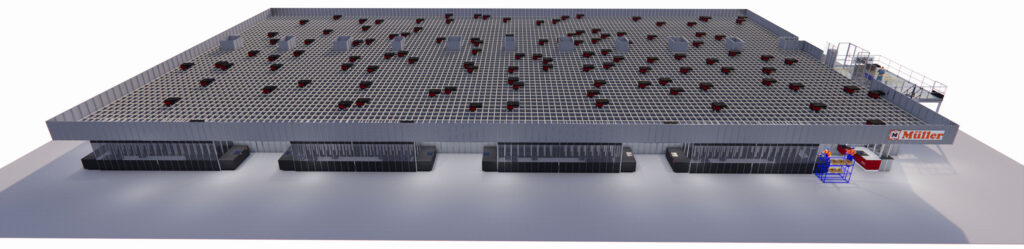
When the 4PL company Müller – Die lila Logistik in Germany expanded into books and media, warehouse automation became a serious strategic consideration.
CFO Rupert Früh reflects on how the company evaluated its options and what gave him confidence in Element Logic’s business case.
What made automation the right next step for your operation?
We had entered the books and media segment and needed a solution that matched our product profile, seasonal fluctuations, and service requirements. Over roughly ten months, we evaluated eight systems before narrowing the choice to two final options. In the end, Element Logic stood out because it fit our operational structure best.
What mattered most when you evaluated the business case?
From a finance perspective, the question was whether the expected operating benefit justified the capital employed. We looked closely at the size of the investment, the resulting depreciation and capital cost, andthe extent to which labor requirements could be reduced over time.
But that was not enough on its own. We also had to be confident that the solution matched our business profile. In our case, that meant looking at turnover patterns, seasonality and the mix of fast- and slow-moving products. Scalability was important too. Reviewing a business case from multiple perspectives has proven to be more than helpful.
How did you get comfortable enough to sign off on the investment?
We did not base the decision on one calculation alone. We built the model using internal experience, worked through it with Element Logic, and then had it reviewed by an external automation consultant. Different people refined the calculations several times, but the deviations in the numbers stayed within an acceptable range.
That was important. You never get perfect certainty with an investment of this size, but when different parties tested the case from different angles and arrived within a similar range, we gained confidence in that the business case from Element Logic was robust enough to support the decision.
What were the main risks from your perspective?
For us, the biggest risk was not the concept itself, but the implementation in a live operation. We were introducing automation into an existing warehouse while continuing to serve customers. That makes everything more complex. You are adapting the building, creating temporary workarounds, moving parts of the operation around, and trying to maintain service levels at the same time.

One more specific concern was the pricing of the storage cubes for the second implementation phase. The material cost is linked to plastics indices, which makes it difficult to lock in pricing over a longer period. In the context of the overall investment, that risk was acceptable, but it was still part of the picture.
Rupert Früh, CFO at Müller
What did you learn during the implementation phase?
That this phase deserves more attention than it often gets. You do not simply install the system and switch overnight to the target performance. Stable productivity takes time. In a live warehouse, the transition phase is an operational and financial exercise in its own right, and it should be evaluated with the same discipline as the final ROI.
What advice would you give other CFOs considering automation?
Automation can absolutely be a sound investment. But my advice would be to look carefully at the implementation and ramp-up phase, not just the end-state business case.
With Früh’s perspective in mind, the rest of this white paper explores the financial questions CFOs should ask when evaluating warehouse automation.
What You’re Actually Buying
When a warehouse automation proposal lands on your desk, it typically reads like a list of equipment. That fails to capture what really changes.
The real purchase is capacity to handle higher volumes without adding proportional headcount. Capacity to absorb flash sales and seasonal peaks without temporary labor. Capacity to ship faster, pick more accurately and hold customers you would otherwise lose to a competitor who already made this investment. The cost structure improves too, because fulfillment costs fall as volumes rise instead of scaling with them. But the growth enablement comes first.
An Element Logic solution is built in three layers, and understanding each one separately is the clearest way to see where the money goes and what it does.
Layer one: The physical infrastructure
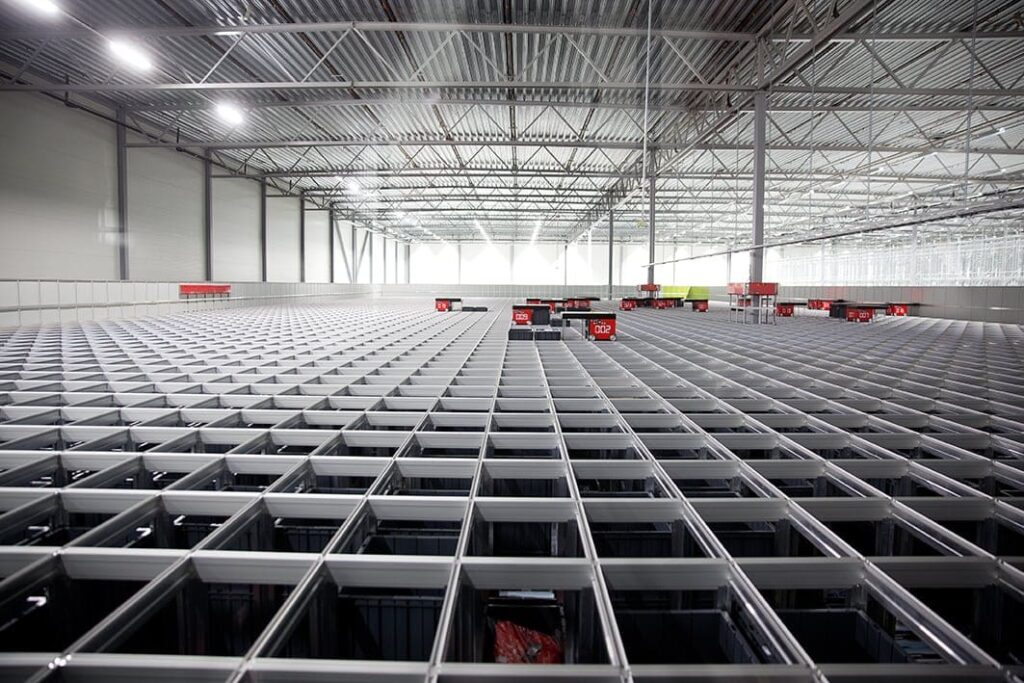
At the core sits AutoStore, a robotic storage and retrieval system (ASRS) that stores inventory in a high-density grid and delivers it to operators at ergonomic workstations. Element Logic designs the system and the material handling that connects the rest of the warehouse:
- Automatic storage & retrieval (ASRS + Shuttle)
- Robotic piece-picking (RPP)
- Packaging and carton erecting
- Conveying
- Sorting
- Autonomous mobile robots (AMR + AGV)
- Operator assisted solutions
- Static storage
- Pouch sorters
Configuration varies, but the principle does not. Goods move to people instead of people walking to goods.

Layer two: The software
Element Logic has built its own software platform that coordinates all equipment in real time. Our Warehouse Control Systems manage order priorities, routing and rerouting when conditions change. Our Warehouse Intelligence tools add visibility into throughput, bottlenecks, workforce productivity and storage utilization. The software works alongside your existing WMS and ERP, not as a replacement.
Layer three: The services
Element Logic delivers design and consulting, project implementation, lifecycle support and Automation as a Service (AaaS). This layer determines how fast you get to value and how the system performs over time. Lifecycle support shifts maintenance from reactive to planned, which protects uptime and makes operating costs predictable.
The service layer can also improve performance after go-live. By using live operating data to identify inefficiencies and fine-tune system performance, Element Logic can help customers improve productivity over time, not just maintain the system.
AaaS bundles equipment, software and services into a subscription model with full cost predictability and is covered in detail later in this white paper.

What this means financially
Most business cases for automation focus on how many years it takes for savings to cover the investment. That calculation matters, but it only captures one side.
The other side is what the investment enables. Higher throughput with the same or fewer people is an efficiency gain that drops straight to the bottom line.
If your company trades at five times profit, and the system saves $500,000 a year in operating costs, you have added $2.5 million in company value. In many cases, that exceeds the cost of the system itself.
Jeremy Clouston-Jones, Vice President Sales Group at Element Logic
Then there are the gains that don’t show up in a payback model at all.
- Growth enablement: Faster delivery, better service levels and the ability to handle more volume can help win new business and retain existing customers
- EBITDA improvement: Higher pick accuracy, lower error costs and less manual handling improve operating efficiency and protect margin
- Commercial flexibility: The ability to absorb volume spikes without emergency hiring makes it easier to support campaigns, new customers and seasonal peaks without destabilizing the operation means
This is the main difference between total cost of ownership and total benefit of investment. Most proposals only show you the first number. Both belong in your decision.
COO vs. CFO
Two Roles, One Decision
Warehouse automation is typically driven by operations and approved by finance. That means the proposal you receive is framed around operations priorities. Knowing what they optimize for helps you spot what’s missing and where to add your own lens.
What operations will focus on
- Pick speed, line throughput and delivery precision
- Stable operations during peak periods
- Reducing manual handling, errors and reliance on temporary labor
- Technical fit with existing processes and systems
- Implementation timeline
What you will want to add
- Cash flow, return on invested capital and payback period
- Whether to fund through capital expenditure, leasing or subscription model
- Impact on the balance sheet and income statement
- Risks around cost overruns, integration delays, uptime and vendor dependency
- How costs evolve over the full 30+ lifecycle of the system, what mid-life reinvestment looks like, and what it costs to change direction

Why it matters to get involved early
When you enter at sign-off stage, the financial upside gets undersold. Savings in cost per order, reduced floor space and lower headcount dependency all improve margins permanently. In a privately held company, those margins gain multiply through the valuation. That argument rarely makes it into a proposal built by operations alone.
A business case you co-build is easier to defend to the board than one you simply approve of.
Why Element Logic?
Element Logic is one of the world’s largest warehouse automation integrators, with operations across Europe, the Americas and Asia-Pacific. We have grown revenue by 30 percent year on year since 2014, and the 2022 acquisition of SDI in the U.S., along our 2025 acquisition of SSS in Australia, expanded both our global footprint and our offering capability.
We have built and tailored our own warehouse control software and design complete solutions around AutoStore, conveyors, robotic picking, packaging, sorting, autonomous mobile robots, operator assisted solution, static storage and pouch sorters. That means one partner across the full warehouse, with the financial stability to stay with you for the lifetime of the investment.
The numbers that matter
The Financial Variables
That Drive Your Return
The financial outcome of a warehouse automation investment depends on a handful of variables. Some will improve your return directly. Others protect it.
Understanding both, and knowing which questions to ask before you commit, is what separates a business case that holds up from one that erodes quietly after go-live.
Across our projects, customers typically see meaningful reductions in fulfillment cost per order and warehouse labor requirements when moving from manual to automated, goods‑to‑person operations.
The exact impact varies by labor costs, order profile, volume volatility, and the starting level of automation. What remains consistent is the underlying effect. Companies can achieve higher throughput with the same or fewer people, and a cost structure that improves as volumes grow rather than scaling linearly with headcount.
For that reason, the most reliable approach is to model the impact on productivity, labor demand, and cost per order using your own volumes and operating profile.
- Labor
- Modularity
- Uptime
- Pick accuracy
- Throughput
- Valuation
Labor is the variable with largest impact
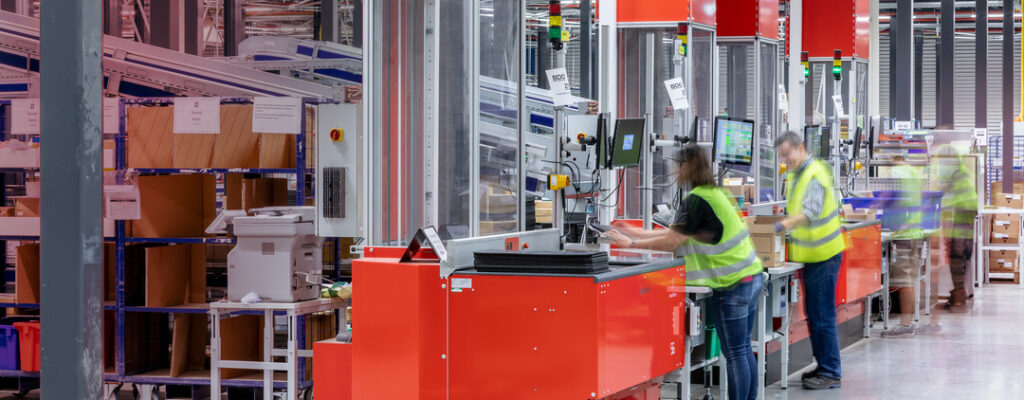
Labor is the variable with the largest impact because manual warehouses spend a large share of labor time walking, searching, picking, and transporting goods internally. A goods-to-person system removes most of that. The same operator handles more order lines per hour because the product comes to them instead of the other way around.
That productivity gain is where labor savings come from. You run the same or higher volumes with fewer people, and the people you keep are doing higher-value work at a fixed station rather than covering distance on foot. Over time, as volumes grow, the gap widens further because you are adding throughput without adding proportional headcount.
✍️ Before you sign, ask the vendor to show the expected lines per labor hour at your volumes, and compare it against what your operation delivers today. That ratio, total order lines divided by total labor hours including temporary staff and overtime, is the clearest way to test whether the promised productivity gain is realistic.

Modularity changes the risk profile
With conventional automation like shuttle systems, you typically design a target capacity and build it all at once. If volumes grow faster than expected, you are constrained. If they grow slower, you are paying for the capacity you are not using. Either way, you are locked into a forecast you made years earlier.
A modular system like AutoStore works differently. You can start with the capacity you need now and expand by adding robots, bins, and ports as volumes grow. The grid itself is designed for that. There is no need to overbuild on day one to avoid painful retrofit later. That changes the risk profile of the investment.
Element Logic’s software layer can simulate how the system performs at different volumes and configurations before you commit to the next expansion step. That means each scale-up decision can be based on actual data from the running operation, not a projection from three years ago.
✍️ Before you sign, ask the vendor to show what it costs to expand the system by 20 or 50 percent, and how long that expansion takes. If the answer involves a major rebuild, the modularity may be more limited than the proposal suggests.
From the CFO perspective:
Scalability was a critical factor in our decision. When we invested in warehouse automation from Element Logic, we had ambitious growth plans, but also a high degree of uncertainty. From a CFO perspective, it was essential not to overcommit capital upfront, but to retain flexibility.
Ronny Höhn, CFO at Bergfreunde
Uptime belongs in the contract
The difference between 97 percent and 99 percent uptime looks small. However, during a peak week in a high-throughput warehouse, it can mean thousands of delayed orders.
✍️ Before you sign, make sure the proposal includes a clear uptime commitment with defined consequences if it is not met. If the vendor is confident in the system, this should not be a difficult conversation.
Did you know?
AutoStore solutions installed by Element Logic have a documented uptime of 99.7 percent across 500 global installations.
Pick accuracy has a direct cost
Every mispick generates a return, replacement shipment, and customer service interaction. In high-volume operations, even a small error rate adds up fast.
When the goods are guided to the picking stations by software, it reduces the most common sources of manual picking errors, such as walking to the wrong location or pulling the wrong product from a shared shelf.
The financial value is straightforward to modeling. Take your current mispick rate, multiply by the cost of processing a return and reshipping and compare it against the accuracy the new system is designed to deliver.
✍️ Before you sign, ask the vendor to quantify the expected pick accuracy of the proposed system, and ask how it compares to your current operation.
Throughput at peak still has to make financial sense
Average throughput is easy to promise. The important question is whether the proposed system can handle peak volumes without being oversized for the rest of the year.
In a manual warehouse, peak usually means temporary staff, overtime, and longer lead times. The cost is high and the quality tends to drop. An automated system should solve that problem without creating a new one. It should run efficiently in normal operation and still give you enough flexibility to handle short periods of much higher demand.
That matters because the investment has to pay back across the full year, not only during a few busy weeks. The strongest solutions are not built only for peak. They deliver savings in day-to-day operation and still have the capacity to stretch when volumes spike.
Element Logic’s software can simulate both normal and peak scenarios using your actual order data. That makes it possible to test whether the proposed configuration is balanced, efficient in everyday use and robust enough to handle peak periods.
✍️ Before you sign, ask the vendor to show how the system performs at peak volumes and how the business case holds up during the rest of the year.

The permanent cost reduction
In a privately held company, a permanent reduction in operating costs flows straight through to valuation. If the business trades at five times earnings and the system saves half a million a year, the enterprise value increases by two and a half million. In many cases, that exceeds the cost of the system itself.
It is worth running that calculation before you evaluate the payback period, because it reframes what you are actually deciding. The exact multiple depends on your business, your sector and how a buyer or board values savings versus one-off gains. But the principle holds. A permanent cost reduction is worth more than the number on the invoice.
✍️ Before you sign, run the valuation calculation with your own numbers. Take the annual saving the vendor is projecting, apply the multiple your business trades at, and compare that figure to the total investment.
From the CFO perspective:
“After automating with Element Logic, three areas stand out from a financial perspective.
First, efficiency-driven ROI. Automation has increased our labor productivity, especially in outbound, resulting in higher throughput per employee and a structurally improved cost base.
Ronny Höhn, CFO at Bergfreunde
“Second, space efficiency and capital discipline. AutoStore’s high storage density reduces the need for additional warehouse space and allows us to defer or avoid capital-intensive expansions of our physical footprint. Third, scalable returns.”
Total cost of ownership
The Full Investment Picture
The previous section covered the variables that drive the return on a warehouse automation investment. This section covers the full cost side of the calculation.
The hardware, software and services described earlier in this white paper make up the core of the investment, but they are not the full cost. Here is the full picture:
Building and infrastructure
The condition of the existing warehouse affects the total cost of the project. In some cases, the building is already well suited to automation. In others, adjustments may be needed, such as flooring, fire protection, power supply, or climate control.
These are standard parts of planning rather than unusual extras. The important thing is to assess them early, cost them properly, and include them in the investment case from the start.
✍️ Before you sign:
Make sure the proposal clearly shows which building works are required, who is responsible for them and whether they are included in the total project cost.
Integration and IT architecture
Your WMS, ERP and order management systems all need to communicate with the new automation layer. That work falls partly on your own IT team and can take internal resources over a short period.
✍️ Before you sign:
Agree with who owns the integration work and what happens if it runs over time or budget.
Process design and training
Warehouse workflow changes after automation. Roles shift, routines are different, and the team needs time to learn. That has a cost in hours and in the temporary productivity drop while people adjust.
✍️ Before you sign:
Budget this explicitly and agree with the vendor about what support they provide during the transition period.
Maintenance and operations
Service contracts, spare parts, energy costs and internal technical staff are ongoing costs that continue for the life of the system.
✍️ Before you sign:
Ask for a ten-year maintenance trajectory, including service contracts, spare parts and technical staffing. A vendor who is confident in their system should be able to show stable, predictable costs across the full horizon.
Transition downtime
Depending on the project, you may run parallel operations for a period, maintain temporary capacity with a third party, or accept reduced throughput during cutover. That disruption has a financial impact and should be budgeted explicitly.
✍️ Before you sign:
Make sure the cutover plan is explicit, and the financial impact of reduced throughput during go-live is budgeted.
Building the full cost picture
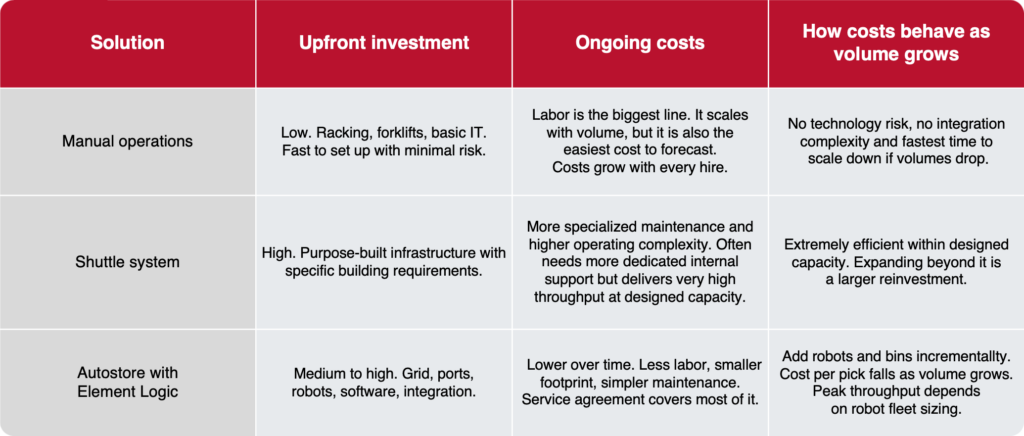
Manual, shuttle or cube-based – where does the money go?
With the full cost picture in front of you, the next question is which type of solution that cost picture looks best in.
Each approach has a different cost profile, and the real differences show over time. The table below compares the three most common solutions across upfront investment, ongoing cost, and how these costs behave as volumes grow.
The KPIs worth tracking
Once a system is live, the financial story moves from the business case to the operating data. These are the metrics that connect what happens on the warehouse floor to what shows up in your results.
Cost per order line: Total fulfillment cost divided by lines shipped. This is the clearest single measure of whether the investment is being delivered.
Lines per labor hour: How much output you get from each hour of warehouse labor. As automation takes on more of the picking work, this number should rise.
Uptime: The percentage of planned operating time the system is actually running.
Throughput vs. plan: Actual output against the design capacity. Tells you whether the system is performing as sold and where there is room for growth.
Error rate: Mispicks and failed shipments as a share of total orders. Lower errors mean fewer returns, lower handling costs, and fewer unhappy customers.
Space productivity: Orders or storage locations per square meter. Relevant if the investment was partly justified by avoiding a new building or additional lease.
Maintenance cost as a share of the original investment: Keeps your running costs honest over time and flags early if the system is aging faster than planned.
Once the contract is signed, most CFOs hand over to the operational team and move on. That is understandable, but it leaves a gap. The benefits you signed off on need someone watching to make sure they are being realized.
Staying involved, even lightly, means you catch it early if performance drifts, and you are the first to know when new opportunities emerge.
Financial models
The Funding Decision
By the time you know what the system costs, what it saves, and roughly when it pays back, the question that remains is how you want to pay for it.
Element Logic offers three ways to fund a warehouse automation solution. Each has a different effect on your cash flow, your balance sheet, and your total cost over the life of the investment.
Buying outright (Capex)
You pay upfront, own the system from day one and depreciate it over its useful life. The asset sits on your balance sheet, which affects how your reported profitability looks over time. Over a long horizon, it is typically the lowest total cost of the three options.
The trade-off is that you commit a large sum of money at the start. Maintenance and spare parts remain your responsibility, though Element Logic’s service agreements cover a significant part of that ongoing cost. Companies with strong balance sheets and long investment horizons tend to prefer this option.
Leasing
Leasing is a middle path. You do not tie up a large sum of money at the start, but you end up owning the system when the term is done. You pay a fixed amount each month over typically five to seven years, and you can choose between financial or operational leasing. With financial leasing, your monthly payments are higher, but the buyout at the end is close to nothing. With operational leasing, your monthly payments are lower, but you pay a residual value when the term finishes.
One practical point worth knowing is that leasing is typically secured against the equipment itself, so it does not draw on your existing credit lines or require additional collateral. That matters if you are managing debt covenants or want to keep your credit capacity free for other priorities. On the balance sheet, both structures may create a financial obligation under IFRS 16 (which governs how leases appear in financial statements) depending on how your auditor classifies the agreement.
Automation as a Service (AaaS)
With AaaS, you subscribe to a fully operational system rather than buying one. Element Logic owns and runs the equipment, and you pay a fixed monthly fee that covers hardware, software, monitoring, maintenance and spare parts, so the cost is predictable from day one and stays that way.
Element Logic guarantees uptime and throughput, which means that if the system underperforms, fixing it is our problem and our cost. Contracts typically run for five years, and when the term ends, you can extend or exit. If you choose to leave, we cover the decommissioning.
AaaS costs more in total over the long run than buying outright – you are paying for certainty, for the transfer of risk and for keeping your capital free to use elsewhere. For a full picture of how this model works in practice, see our dedicated AaaSwhite paper.
Choosing the right financial model
The table below is a way to orient the conversation. It is not a recommendation. The right answer depends on your capital structure, your time horizon, and how you want to manage the risk.
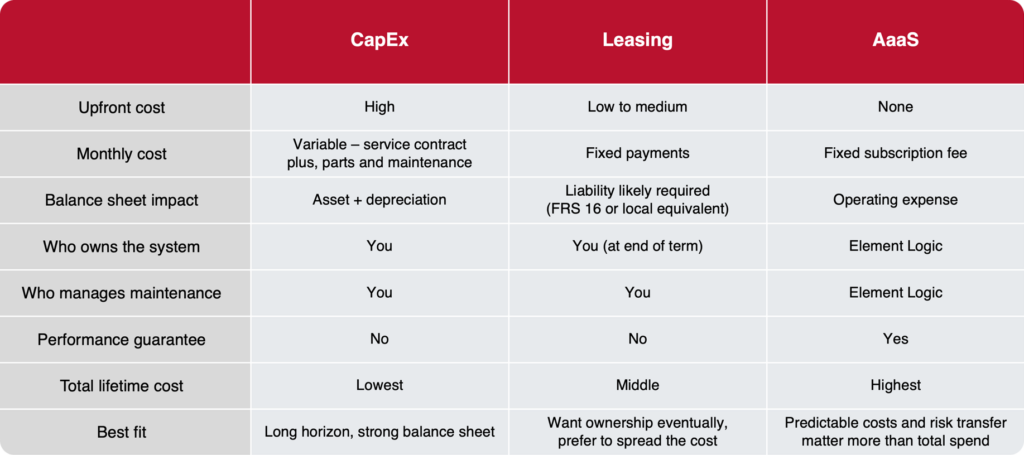
Element Logic can model all three options against your specific numbers, so you can see the cash flow and total cost side by side before you decide.
Risk & governance
How to Manage the Risk
As the person signing off on this investment, your job is to make sure the risks are understood before you commit. Here are the risks that matter most.
The business case
Every investment case rests on assumptions about labor costs, volumes, and growth. If those assumptions are wrong, the payback takes longer than you told the board. Build the business case on conservative assumptions, run sensitivity analysis and stress-test the numbers before you commit.
Element Logic has worked through this across more than 600 projects and can help you build a business case you can stand behind.
From the CFO perspective:
We paid close attention to execution risk and downside protection. Execution risk meant integration across WMS/material flow/ERP and embedding the system into operations without disruption. To protect the downside, we ran the ramp-up with strict KPI transparency and an iterative test-to-learn-adjust model, so deviations surfaced early and could be corrected fast.
Ronny Höhn, CFO at Bergfreunde
Vendor lock-in
Once you automate with a single provider, switching is expensive. But the risk is more manageable than it appears.
The AutoStore grid is an open hardware platform. You are choosing Element Logic for the software, design and service layer, not locking into hardware only one company can touch.
To protect yourself further you can keep hardware, software and service agreements contractually separate, so you retain leverage at renewal. Ensure your operational data is portable. And agree renewal terms and price escalation caps before you sign, not when switching costs make walking away impractical.
Ultimately, the strongest protection against lock-in is choosing a partner with the financial stability, track record and scale to remain a reliable partner for the full life of the system. A 15–20-year commitment demands a vendor you trust to still be there and still be investing in the technology a decade from now.
Implementation risk
Integration, cutover, and go-live carry real financial exposure. Ask for a clear implementation plan with defined milestones and acceptance criteria before you sign and make sure it is clear who bears the cost if something slips.
One way to reduce implementation risk is to opt for a phased go-live, and start with part of the operation rather than cutting over all at once.
Performance and technology obsolescence
If the system fails to deliver the uptime or throughput you signed off on, the business case erodes quietly and often without an obvious alarm. Over a long horizon, you also need to ask whether the technology can keep pace with your business without requiring a full replacement mid-contract.
One way to minimize this risk is by choosing a subscription model like AaaS. With AaaS, both performance and software updates are included as standard. If you are buying or leasing, the equivalent protection is a strong SLA with explicit uptime and throughput targets and clear consequences if they are not met.
Organizational change
Automation changes how your warehouse operates and what your people do. Roles shift, some disappear, and the team needs time to adapt. The risk is resistance, turnover of experienced staff, and a temporary productivity drop while the organization adjusts.
Managing the people side of this transition is as important as managing the technical one. Ask the vendor what change management support they provide as part of implementation.
Volume downside
The business case for automation is built on volume assumptions. Most scenarios model growth. But if volumes drop significantly and permanently, due to lost customers, a market shift or an economic downturn, the cost structure of an automated warehouse is less flexible than a manual one.
Under CapEx or leasing you still carry the depreciation or lease payments regardless of throughput. Make sure you understand your cost floor and what the investment looks like in a downside scenario, not just the base case.
FAQ
Warehouse automation raises a lot of questions. These are the questions that tend to come up in almost every conversation with a CFO.
Hiring more people and expanding buildings are both valid for short-term responses, but neither changes your underlying cost structure. Labor costs rise every year and scale with volume, while a building expansion is expensive and difficult to reverse. Automation replaces that variable, unpredictable cost with a fixed one, and that difference becomes more valuable the longer you run the numbers.
No. An AutoStore solution by Element Logic integrates with your existing WMS rather than replacing it. The integration work is part of the project scope, and Element Logic manages it as part of implementation.
For most operations, payback falls between three and five years – but this varies significantly depending on labor costs, order volumes and the funding model chosen.
Solutions delivered by Element Logic are modular, which means capacity can be added incrementally as volumes grow. A significant and permanent drop in volume is a more complex conversation, and the right answer depends on which funding model is in place.
That depends on how the investment is funded. A Capex purchase creates an asset that is depreciated over time. Leasing may create a liability depending on how your auditor classifies the agreement. A subscription (AaaS) runs entirely through the profit and loss account as an operating expense with no capital asset recorded.
Under AaaS, you can exit after the minimum contract term and Element Logic handles decommissioning. Under leasing, exit terms depend on the agreement structure. Under Capex, you own the asset, and any exit decision is yours to make.
Implementation timelines vary depending on the size and complexity of the solution, but most projects run over several months from contract signature to go-live.
That also depends on the funding model. Under AaaS, Element Logic retains responsibility for performance, maintenance and software. Under Capex and leasing, day-to-day operations and maintenance sit with you, supported by a service agreement.
Peak performance is one of the most important things to validate before you commit. Solutions built on AutoStore can increase throughput by adding robots and ports rather than redesigning the system. Our software can also simulate peak scenarios using your actual order data before the system is built. Make sure the peak is specified in the contract.
The Next Step
Every company has more investment proposals than capital. Warehouse automation has to earn its place alongside IT upgrades, acquisitions and store refurbishments.
What makes it easier to defend is that the efficiency gains are permanent and scale with volume. A system installed today handles more orders next year without additional spend.
What it buys is not a cost saving. It is a capacity. The capacity to grow without adding proportional headcounts. To absorb peaks without emergency hiring. To win more customers. And to see the value of the company increase by a multiple of what the system costs to run.
Lower operating costs, stronger competitiveness, and higher company value. That combination is rare in a single investment.
The next step is a conversation with numbers that reflect your own operation, not generic benchmarks. We have built business cases like this hundreds of times, across different industries and funding structures, and we know where the assumptions tend to break down.
If you are ready to see what the numbers look like for your operation, reach out below.